The chapter meeting was held April 3. The mart and exhibits were going full-swing when Brooks Coleman launched into the auction. We had more items than usual, which kept the bidding fast and furious. Our usual auction was even more exciting with all of the anxious bidders, and Brooks Coleman knows how to keep an auction moving.
Upon completion of the auction, Jeff Jacobus started the business meeting by welcoming our guests who were then asked to introduce themselves. Bob Booth gave the treasurer’s report and reminded everyone that after June, the chapter newsletter will be discontinued for those who neglected to renew their membership.
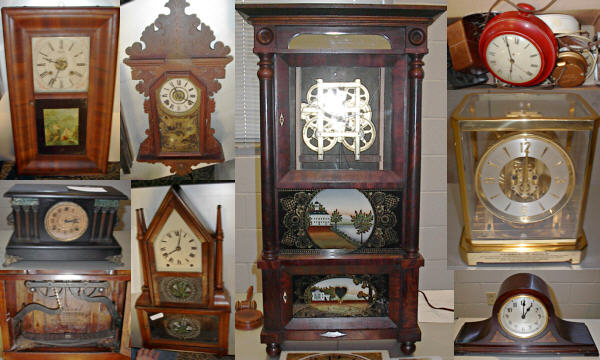
In our Dec. newsletter we mentioned a clock that the chapter was working on for the A H Stephens Park, in Crawfordville, GA. This beautiful triple-decker is now ready to go home. The restoration committee, headed by Ward Francillon brought life back to a shell of a case with only the movement inside and nothing to hold it up. Bernie Tekippe and George Waterhouse worked on the 8 day brass strap movement, patented in 1833 by Joseph Ives. George also worked on the case, having to rebuild the seatboard, side supports and pulleys. Chris Martin donated the weights. Rick Mangum did a wonderful reverse paining on the tablets and Kathy Edwards expertly restored the dial. Since the case had no internal parts or label, it is unknown who the maker is, but believed to possibly be John Birge. It was suggested that a cover letter be written about the restoration and the people involved, along with the clock’s value. The letter and clock will be presented to the state’s Department of Natural Resources.
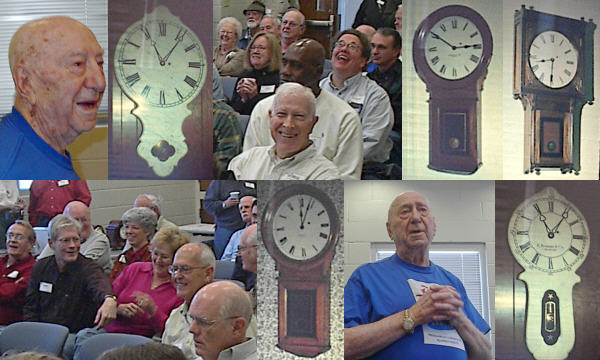
Mike Mellard introduced our speaker Joe Glass. Joe is a collector of American clocks and shared a slide show of some of his collection. Before the lights went out, he showed us a couple of special items. With reference to the article in the February Bulletin, Joe held up a roasting rack. It hangs beside his fireplace, and it works. He also had a brass bucket, patented in 1853, spun out of a brass circle. What does this have to do with clocks? It was made by the Ansonia Brass Co.
Joe is a lover of Howard clocks and decided that he wanted a complete set of Howard banjos. After finding someone claiming to have a set for sale, Joe purchased all but the #3. When you want a set, always remember there’s one that’s hard to come by. The set is still not complete after 20 years of searching. Among his collection was the Howard #11, with a U shaped weight to fit the bottom of the clock, otherwise it would not run a full 8 days, and a Howard square bottom banjo, the only one made where the movement was not signed.
Joe concluded saying he never bought a clock that he didn’t want to keep.
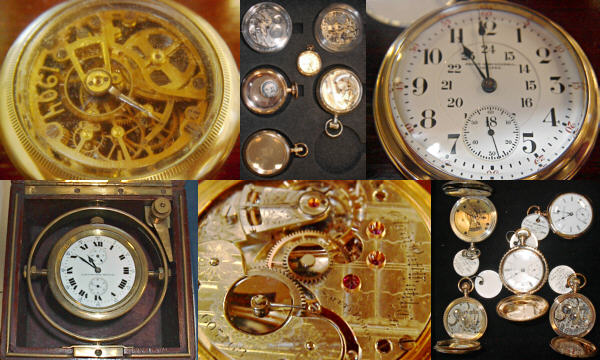
Another 18-size, J.P. Stevens hunting-case movement, made by Aurora and fitted with Stevens' patented regulator changed hands in the mart. The moderately large number of watches included a variety of railroad grades, including some examples of Dueber-Hampden's Railway grade.
The Watch Focus Group turned its attention to 19th century Elgin watches. Among the many watches brought in, one was most unusual - a skeletonized movement in a display case. The dial appeared to be a brass disk with almost everything cut away to the rim, with the exception of the seconds bit and a series of circular tabs bearing the hour figures. It is supposed that it was created by a student at a watch school. Another mentionable was a 21-jewel grade No. 72 convertible in a gold hunting-case. This high-grade model was created by Elgin to permit the winding stem to be field fit in either the 12 o'clock or 3 o'clock position. The intention was to allow jewelers to reduce inventory since the movement could be correctly mounted in either a hunting or open face case. A keywind/keyset grade No. 69 B.W. Raymond represented Elgin's earlier period. Also, there was an Elgin Veritas from the first run, at the dawn of the 20th century. It has a wonderful Canadian dial signed "ARCHD M. MCDOUGALL, WINNIPEG.