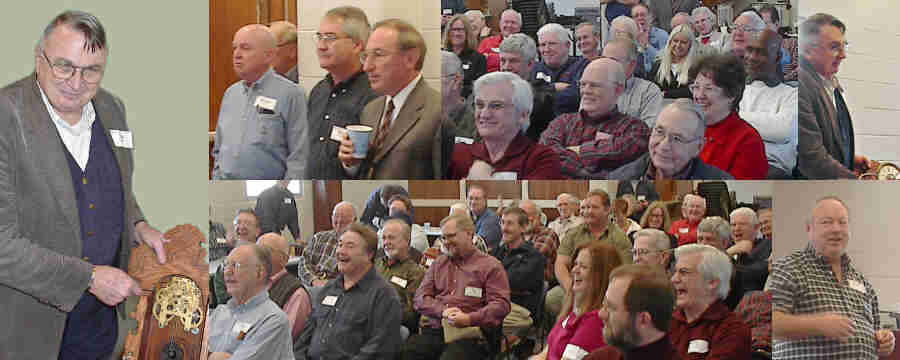
The chapter meeting was held February 6. It was a wonderful turnout for the first meeting of 2005. Our usual auction was even more exciting with all of the anxious bidders, and Brooks Coleman knows how to keep an auction moving.
Our speaker, Tom Fowler gave us good "Advice for Buying Right." Although mainly pertaining to clocks, many of Tom's points apply to watches as well. Having information helps to make good buying decisions. The first thing is to read reference material to be familiar with what you want. Then, always take a few small tools with you. You'll need a screwdriver so you can remove the dial to see many inside. Do the movement and dial match or is it a Seth Thomas movement with an Ansonia dial and case? You can also see how the movement fits and if it is in the original mounting holes. If the case looks like Swiss cheese where the movement mounts, they probably didn't start life together.
Also take along a multi-pronged key. Check to see if you can wind the clock. If any of the arbors don't wind, you could be dealing with a broken spring or click. Either one can cause traumatic damage throughout the movement and it may not be worth buying. Look in the back to see if all the parts are there. Make sure you see wheels between the plates, whole trains have been found to be missing. An angled small mirror can help with some of the inspections. Watch out for steel plates. They are often corroded and difficult to repair. Beware of solder. Excess solder can be an indication of careless or improper repairs.
Platforms escapements can be risky. If you don't work with hairsprings, and don't know a good watch guy, you may want to steer clear. Platforms can sometimes be replaced for about $100.00, if they can be fitted. If a clock looks old but the edges are too square and there is no dust in the cracks and crevices, it may be a new reproduction.
If the owner won't let you look closely, be wary, they may be trying to hide something. Yet, it pays to remember, the best finds will usually require some repair. Enjoy the restoration process knowing that the prize is in there.
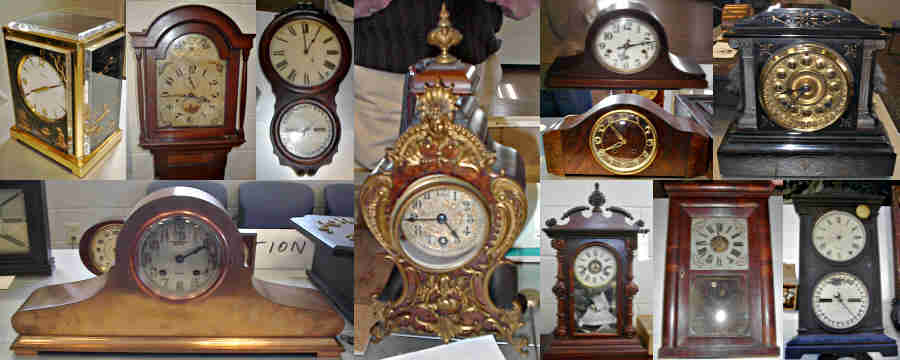
Newly elected president, Jeff Jacobus, brought an unusual Atmos clock, with an Oriental style case, for show. This style isn't often seen. Jeff pointed out that members usually bring in only those clocks that they wish to sell, making the point that we should show off some of our prize pieces as well. As collectors, we have many timepieces, and sharing is part of collecting. One of our new members, Lindsay Rasberry, brought a Silas Hoadley tall case. It's from the early 1800's and is in impeccable condition, from it's wooden works, and it's painted dial, to the original tin can weights and pendulum. It has a case befitting an eight day clock, but this one runs 30 hours.
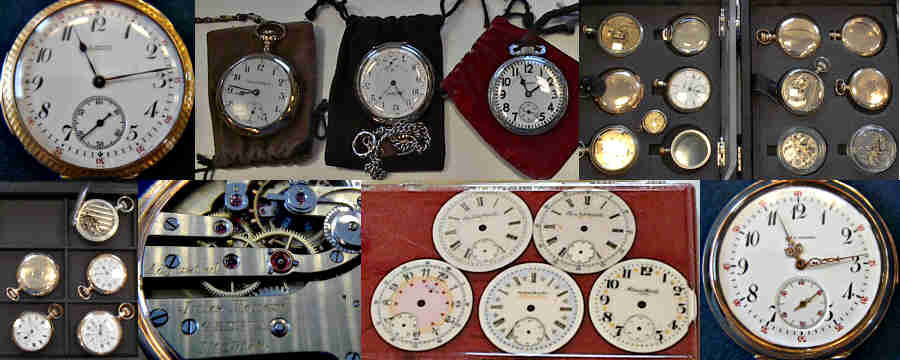
Amongst the many watches for sale, Jim Davis offered a very interesting magnetically shielded case, produced by Fahys in the 1880s-1890s, containing an Elgin movement from that era. From the same period, Louis Christina put out a Peoria, Anti-Magnetic, Superior Quality watch. Both were 18-size and were uncommon examples of the results of the magnetism scare of the late 1880s. Another interesting watch that showed up was an 18-size, J.P. Stevens hunting-case movement, made by Aurora. It was fitted with Stevens' patented regulator and its single-sunk Roman dial was signed "J.P. Stevens & Bro. - Atlanta GA."
The Watch Focus Group turned its attention to 16-size higher-grade Swiss watches. A number of examples from well-known (and some lesser-known) companies were on display. Some carried their manufacturers' names while others were privately labeled. The stars of the display weren't 16-size at all, being closer to 14 or 12-size. There were a pair of open-face minute repeaters in solid gold cases. One was a C.H. Meylan watch and the other was by Audemars, Piguet & Cie. Swiss watches will again be on display in October, when Ed Ueberall will present his paper on Non U.S. Made Watches Used in North American Railroad Time Service. The group will focus on 19th Century Elgin Watches in April and on 1920s Watches in June.