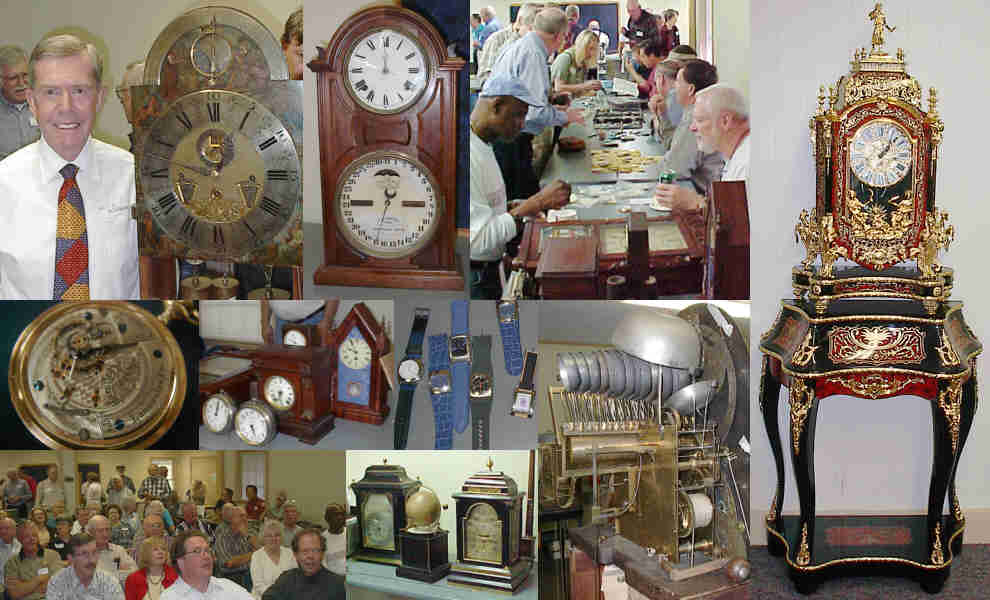
At our August gathering, Brooks Coleman, our resident auctioneer, decreed that bringing a horological item to display or sell was a requirement for admission to the October meeting. Although he apologized for letting his enthusiasm exceed the expressed desire of our board, Brooks' efforts were successful. They resulted in a great increase in the number of clocks brought for display or sale. The amount and variety of watches increased as well, to a bit above their generally high level. Brooks then launched into the auction. He was fairly busy with more than two dozen watches and clocks that were up on the block, more than in any recent meeting.
Immediately following the auction, the business meeting was called to order at 11:30 a.m. by President Tekippe. Six new members and one guest were present. One item of interest was a report that more tables were sold this year than previously at the Mid-South Regional in Chattanooga this past Labor Day weekend.
A brief presentation was given on the significance of 18-size Hamilton watches, the topic of the Watch Focus Group. Hamilton was created in the early 1890's to market watches to the railroad trade, with Webb C. Ball being an early director. The watch display included an uncommon 17-jewel grade 930 in addition to the often seen grades 944 and 946. As might be expected, a large number of grade 940's were exhibited. The Watch Focus Group's subject for the December meeting is 18-size Illinois watches.
Ken Simons displayed a boulle style clock, circa 1948 that sits on a matching console. The two pieces together measured five feet high. This clock, consisting of a German movement and a dial marked LeOre, was made in Italy. Ken has the original bill of sale showing that the clock was sold in France in 1948.
The featured presentation was given by guest speaker Norman Hankins of Jonesborough, Tennessee. He displayed and discussed two Dutch grandfather clocks, five bracket clocks, and a barometer, which together formed a fantastic museum grade collection. The star of the show was an unusual musical tall clock made by Adam Heymeys in Amsterdam, circa 1740. It's a music box type, playing a choice of seven tunes on thirteen bells. It also had automation and all the bells and whistles. Norman discussed the discovery and the tracking down of the items he had on display. His interesting presentation concluded around 12:40 PM.