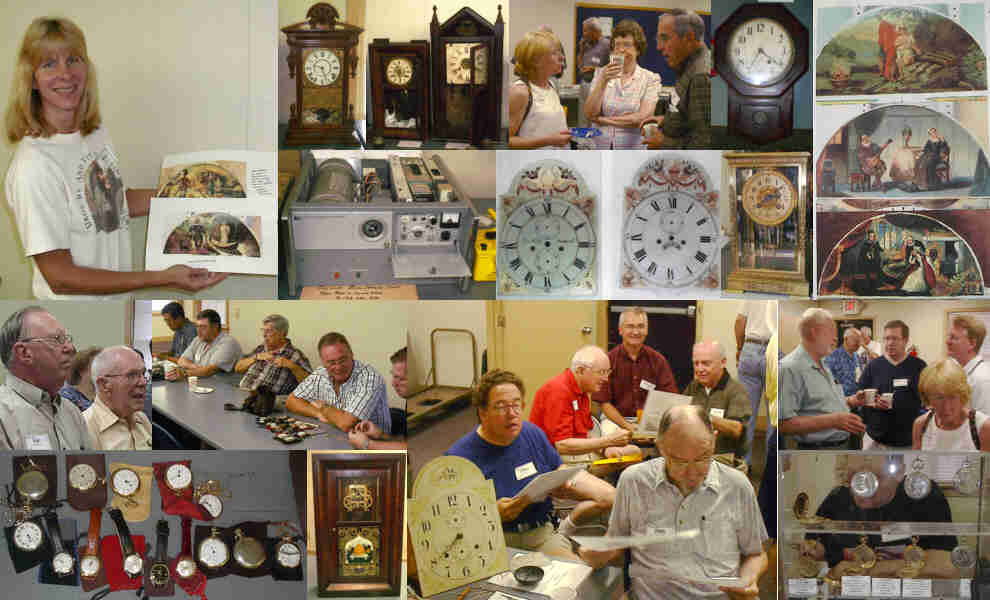
The August meeting started with the lively pre-meeting auction by the always entertaining Brooks Coleman. These auctions, which profit only the buyer and seller, have become a highlight of our meetings and is a regular the feature of the mart. To further encourage the mart, and to increase the number of items brought in for display, it was decreed that in order to gain admission to the October meeting attendees would have to bring a horological item to sell and another one to display. A promise to buy an item in the mart would also be accepted for admittance.
The most interesting clock at the August meeting was brought by Ken Simons, a cesium beam (atomic) clock, on loan from the Dept. of Commerce, Fort Collins, CO. Ken had recently displayed this clock at the NAWCC national convention in Charlotte, NC and will have it on display again on Labor Day weekend at the Mid-South regional convention in Chattanooga, TN. Its next appearance will be at the Mid-Winter regional convention in Orlando, FL in February, 2004. The clock's tour will end in Fort Lauderdale, FL at the 2005 NAWCC national convention.
George Waterhouse displayed the Southern Clock Co. OG clock that he had recently restored. George, a master clock case restorer and all around clock collector, described how he procured the correct veneers and went about the task of rebuilding the clock. We all celebrated his good fortune in finding the correct movement whose foot pattern, center post and winding arbor matched right up to the existing holes.
The Watch Focus Group turned their attention to Hampden's 18-size movements. Hampden upset the market in 1891 when they introduced and heavily advertised their line of 17-jewel watches and a number of examples of these were on display. Perhaps the nicest was brought in by Norman Devane, a first-time visitor to our chapter meeting. His open-face, 17-jewel "Special Adjusted" movement was tricked out with gold trim and looked especially nice. However, the most interesting watch was displayed by Katherine Kittle - a model 2, hunting-case 11 (or maybe 15) jewel watch, signed on its gilt movement, and single-sunk dial, "J.P. Stevens Watch Co. Atlanta, Ga." To top it off, it was fitted with a "Stevens Patent" regulator. The subject of attention for the October meeting is to be Hamilton's 18-size watches.
Kathi Edwards was our main speaker. She, along with her mother and father - Richard and Martha Smallwood, has been restoring clock dials for many years. They are considered the gold standard of dial restoration. Kathi's presentation on painted metal dials, profusely illustrated with slides and with color reproductions that were passed around, captured the attention of the audience from the first minute. Kathi traced the development of dial painting from its beginning in 18th century England to the early and middle 19th work done by well-known dial painters here in the United States. She showed many examples of how the period of time was reflected in the style and content of these ornately painted clock faces.