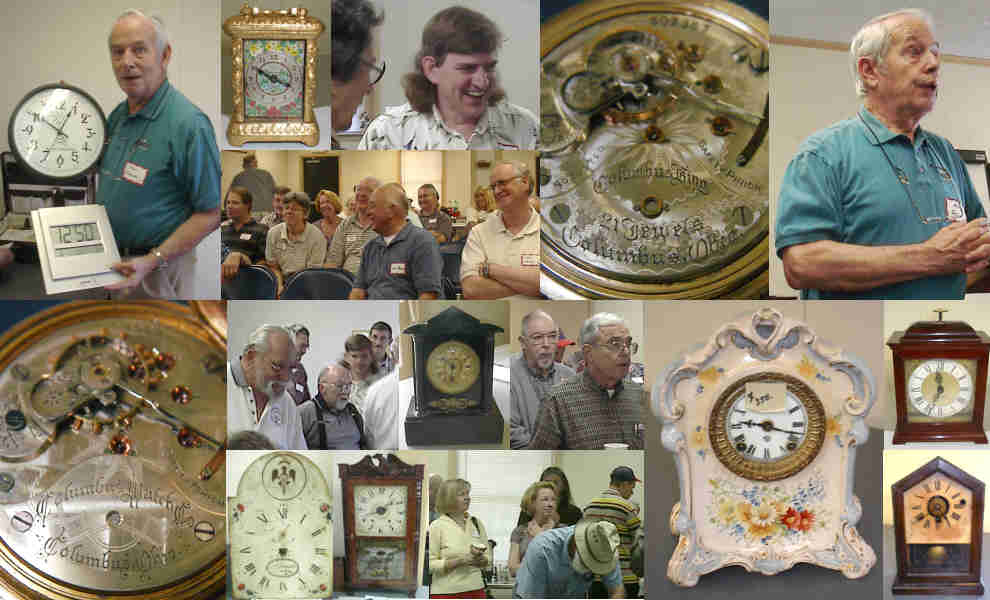
There were several short presentations given to the group by members at the June meeting. The first was on an Ashby movement and dial. An outstanding Silas Terry pillar and splat wood works clock was shown by Ward Francillon. What makes this clock unusual is the fact that it had three springs for the time, strike and alarm, instead of having weights for power. This is the first type of clock mainspring arrangement to be developed in the United States. Terry had patented the springs, the earliest produced in America, in 1830. Kent Singer spoke very briefly about the theme of this meeting's Watch Focus Group display, the Columbus Watch Company's high grade watches of the late 1880's. Bernie Tekippe discussed the NAWCC Bulletin indices, which can be obtained online at the organization's website. As an alternative, Bernie offered to order hardcopy versions of the indices for interested members. He also announced that his shop, Classic Clocks, has undertaken the restoration of the 1886 Seth Thomas tower clock in Covington, Georgia. Gene Wypyski made an announcement that he is opening a clock shop and will be looking for a clock maker and sales representative.
The featured speaker was Ken Simons, who presented a program on his efforts to have a retired cesium beam travel clock donated to the National Watch and Clock Museum (NWCM) by the National Institute of Standards and Technology (NIST). Ken had convinced the U.S. Commerce Department, which is responsible for the NIST, to donate the clock. He is currently in the process of expediting the acceptance of the clock by the NWCM. As part of his presentation, Ken explained some of the services of the NIST, particularly the broadcast of time signal standards from stations WWV and WWVB in Colorado and WWVH in Hawaii. He illustrated his discussion with examples of analog and digital radio controlled clocks that receive broadcast time signals from WWV and WWVB.
The subject of the Watch Focus Group was Columbus watches. The emphasis was on Columbus' production of high grade watches having 15 and 16 jewels during the 1885-1895 era.. There were several examples of 16-jewel watch grades, a tu-tone Railway King and a nickel damaskeened No. 97. Reproductions of Columbus catalog cuts were available for members to determine the grades of their watches, mostly unmarked, by comparing the damaskeening patterns.